GI-MAP Gut Test
Gut testing + a practitioner to explain it · For when you're tired of guessing
Finally know what's actually going on in your gut — with an expert to walk you through exactly what it means.
This isn't just an at-home test. You get the at-home GI-MAP® stool test kit, a recorded video walkthrough of your results, a written report, and a personalized plan from a certified functional practitioner — plus discounts on any supplements you choose. All without scheduling anything or sitting through a series of clinic appointments. So instead of guessing, you finally know.
No waiting months for an appointment. No scheduling. Just answers.
Kit shipped to your door · Results in 2–3 weeks · No appointment required
There's a lot of info here- some quick links to jump to what you need:
I loved the video review of my results. You were patient with all my questions and extremely supportive. Being able to go through you to get these tests and not cost an arm and a leg has been life saving. I truly appreciate all that you have done for me!
— J.E.
You've tried everything
And your gut is still running the show.
You've tried probiotics. Maybe more than one kind. You've added fermented foods, bought the expensive bone broth, tried cutting back on sugar or dairy to see if it helped. You've asked your doctor about it and been told your labs look "normal" — or handed an IBS diagnosis and sent home with no real plan.
If any of this sounds familiar…
- You've walked out of appointments feeling dismissed — brushed off with "everything looks fine" when it clearly isn't
- The reflux, gas, or burping won't go away — and no probiotic or supplement helps long-term
- You have skin breakouts, brain fog, or low energy affecting your day-to-day
- You're self-conscious about bloating that makes you look 5 months pregnant
- Digestive symptoms don't improve no matter how healthy you eat
- You're tired of being your own science experiment
You're not imagining it. Your gut is trying to tell you something — and guessing at what it needs hasn't worked because guesses aren't data.
There's a better way to find out what your gut actually needs — here's how it works ↓
Here's what most people miss
Your gut isn't a mystery.
It's a data problem.
Most gut protocols you've tried were built on symptom-matching: you have bloating, so try this probiotic. You have reflux, so take a PPI. You have IBS, so…
Your doctor said eat more fiber. That internet forum said fiber's the problem.
One podcast swears by carnivore. The next one says meat is inflaming your gut.
Your friend went low-carb and felt amazing. You went low-carb and felt worse.
Add fermented foods. Avoid fermented foods. Only eat them on Tuesdays.
No wonder your gut is confused. You are too.
Here's the thing: the same symptom can come from a dozen different underlying causes. Reflux from H. pylori bacteria is a completely different problem than reflux from too much stomach acid. "IBS" is a label — not a cause. And without knowing what's actually happening in your gut, every protocol is a guess.
This is why the supplements didn't stick. Why the elimination diets might give you a couple good weeks and then stop working. Why the protocol that worked for your friend made you feel worse. You weren't doing it wrong — you were just working without data.
The GI-MAP® changes the conversation. It's a stool test that uses DNA-level technology (qPCR) to identify the actual microbes, infections, inflammation markers, and digestive function happening in your gut right now — so instead of guessing, you can see.
And instead of waiting weeks for a doctor's appointment just to walk out with a prescription — or at best, a rushed list of supplements you don't even know what they do — you get a recorded video walkthrough of your specific results, explaining what they mean, what matters most, and — perhaps most important — exactly what to do next.
Ready to see what's actually going on in your gut?
See the Package →The test is the easy part
Knowing what to do with it isn't.
You have three real options when you want to understand your gut.
You can buy a DIY test kit online. It may be cheaper upfront — and then a PDF lands in your inbox and you're on your own to decode it. No one to tell you which of the dozens of markers actually matters for you, no plan, no context of your symptoms. Data without a guide is just a new kind of guessing.
You can go through a functional clinic. You'll get expert interpretation — after a months-long waitlist, a separate intake appointment, and a one-time call where you're scribbling notes, trying to absorb three months of plan in forty minutes, hoping you remember it all later. Then the invoices: the test, the intake, the consult, the follow-up — hundreds of dollars each.
Or you can do this. The detailed GI-MAP test, interpreted by a practitioner in a recorded video you can pause, rewatch, come back to any time — paired with a written report and a 3+ month plan built around your results. No waitlist, no appointment, no scrambling to keep up. You absorb it on your schedule, as many times as you need.
Most testing makes you choose between affordable-but-alone and guided-but-expensive-and-slow. This is built so you don't have to.
What you'll actually see
A full picture of what's
happening underneath.
The GI-MAP analyzes over 40 markers across the major categories that drive gut dysfunction — a complete picture of your microbiome, digestion, inflammation, and immune function in a single at-home test.
Beneficial bacteria
Why the same probiotic that helped your friend did nothing for you. You'll see which beneficial strains you're actually low in — the ones that keep digestion, immunity, and mood steady.
Opportunistic & pathogenic bacteria
What's behind bloating and reflux that supplements never seem to touch. Includes H. pylori — the most common cause of ulcers — along with overgrowths that quietly drive inflammation.
Parasites, viruses & fungi
The stubborn symptom drivers standard testing tends to miss. These are frequent culprits behind unexplained fatigue, skin flares, and digestion issues.
Inflammation markers
Like calprotectin — a direct measure of how inflamed your gut is right now.
Digestive function
Are you actually breaking down and absorbing your food? We assess enzymes, fat digestion, and other common reasons "eating healthy" still leaves you uncomfortable.
Immune markers
How your gut's immune front line is holding up. Secretory IgA running high or low points to very different problems — and explains where support may be needed first, before all those "detoxes."
The difference: you're getting a lab-grade gut panel shipped to your door — and the interpretation comes as a recorded video you can rewatch as many times as you want.
And here's what you do with it
You won't be left to decode it alone.
The test shows what's going on. These three pieces are how you turn it into something you can actually act on.
Your results walkthrough
A recorded video where I walk through your specific results — what they mean, what matters most, and where I'd start. Pause it, rewatch it, come back to any time.
Your written report
You won't just get a video — you'll get a written report summarizing what your markers mean and breaking down your numbers, in plain language you can come back to anytime.
Your 3+ month plan
The actual what-to-do part: specific steps for diet, lifestyle, and targeted supplements, laid out in phases so you know exactly where to begin — not a pile of data to sort out yourself.
Ready to see what's actually going on in your gut?
See the Package & Pricing →What you'll receive
This is what the lab sends back.
But you're not left to figure it out on your own.
Below are sample pages from an actual GI-MAP lab report — just an example of the format and markers tested. This is what the lab sends: color-coded markers and reference ranges. Accurate, thorough, and almost impossible to act on by yourself. The good news: you'll also receive a full plan from a certified Functional Diagnostic Nutrition Practitioner on how to act on your results and address any imbalances.
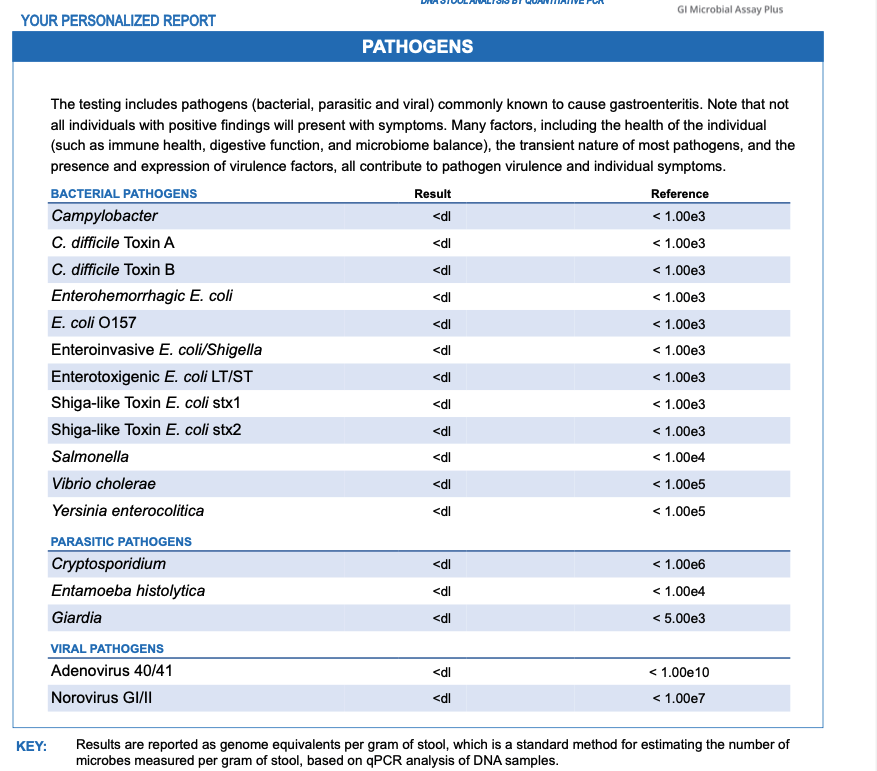
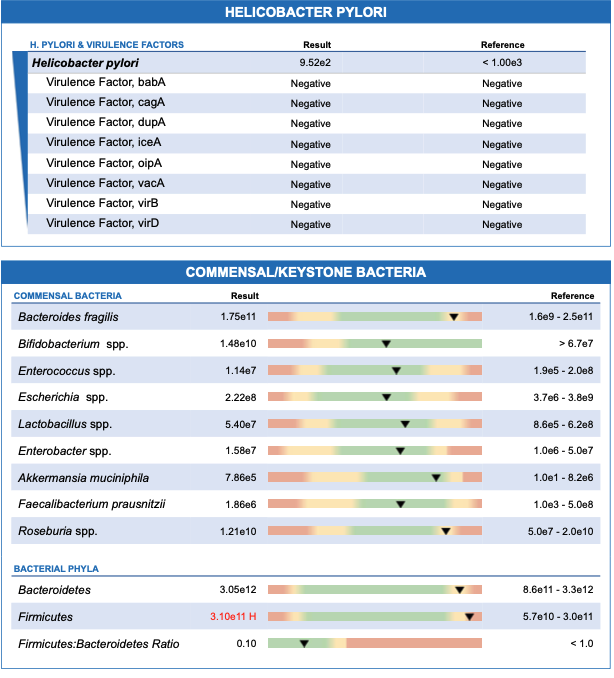
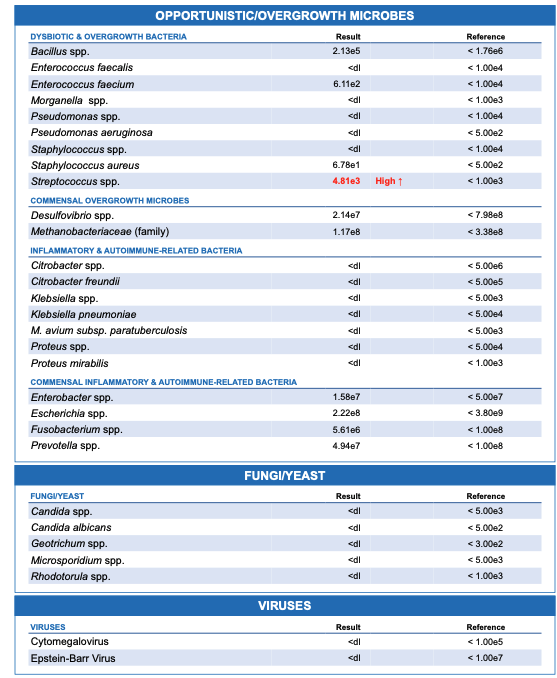
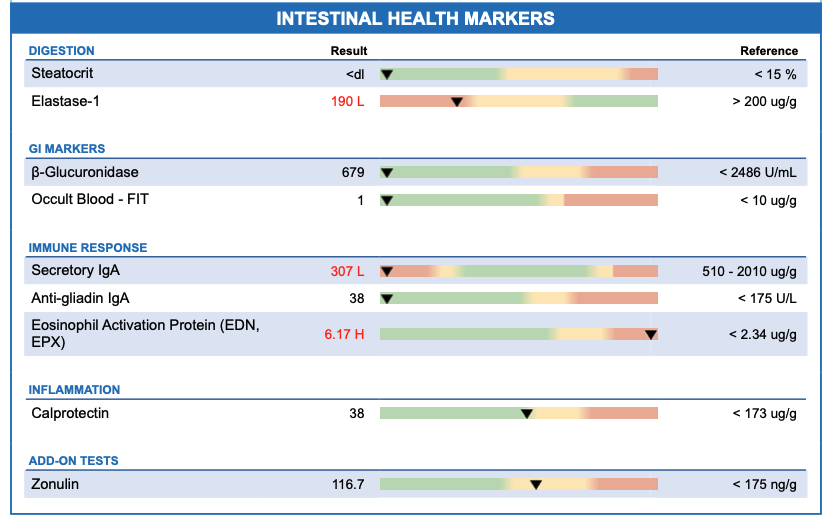
This is the data. What it means for you is the part below.
The Package
What you get —
delivered on your time.
Everything from the test itself to a personalized plan you can actually follow — without scheduling an appointment or making time for a call.
- At-home GI-MAP test collection kit shipped directly to your door — everything you need to collect a small stool sample when it's convenient, and drop in the prepaid mailer
- No waiting weeks (or months) for an appointment. Order today, your kit arrives within days — no scheduling delays standing between you and answers
- A detailed health history + symptoms intake so your results can be interpreted in the context of your story — not just the lab values. All submitted via a secure digital form, no need to have to talk about your symptoms out loud
- Leaky gut / intestinal permeability marker (zonulin) included — an additional marker not on a standard GI-MAP report, for insight into intestinal permeability, especially relevant if you're dealing with autoimmune flares, skin issues, or stubborn food sensitivities
- Personalized recorded video walkthrough of your results — not a live call where you're struggling to understand in real time. Watch on your schedule, replay it, come back to it later as needed to fully understand it
- Detailed written report translating your results into what matters for you
- A customized 3+ month personalized plan with specific next steps for diet, lifestyle, and targeted supplementation — no guessing
- 48 hours of written follow-up after you receive your results - a chance to to ask questions without having to wait, and the option to request future support if you need it
Plus, ongoing perks
- Up to 25% off professional-grade supplements through Fullscript (ongoing, all orders)
- 15% off Cellcore detox products — plus direct access to the Cellcore store (normally practitioner-only), with your discount applied to any future order
No live meeting required.
Everything delivered virtually, on your time.
GI-MAP Test + Practitioner Interpretation + Personalized Plan
If you ordered this piece by piece through a functional clinic — test, intake, interpretation, and follow-up each billed separately — the costs would add up fast. This is why I built this package for you, all included:
$899
Payment plans available at checkout, subject to approval
Questions before you buy? Email me first — I'm happy to help you decide if this is right for you.
What guessing has already cost you
The real cost isn't the test.
It's another year of not knowing, dealing with the same symptoms.
If you've already spent months (or years) guessing — the elimination diets that didn't stick, the probiotics that ended up in a drawer, the expensive cleanses, the doctor visits (hundreds a visit, plus lab costs) — you've likely already spent far more than $899 on not-knowing.
Most functional health offerings (including some of my own) are bundled into longer-term programs — memberships, multi-month packages, or signature coaching. Those make sense if you want ongoing 1:1 support and accountability over months. But if you mostly want clarity — the test, the interpretation, the plan — without committing to a full program, that's exactly what this package is for.
This package gives you:
- The test itself, with free expedited shipping (hundreds $$$ elsewhere, plus shipping costs and slower turnaround)
- No separate intake appointment — securely share your health history through digital forms instead of an extra appointment just for intake (hundreds at many functional clinics, plus months on a waitlist)
- Professional interpretation of your results (hundreds of dollars per appointment at most clinics, where you're left trying to remember everything they said)
→ Yours: a recorded video you can rewatch as often as you need. - Zonulin / leaky gut marker included (typically a premium add-on) — adds intestinal permeability assessment so you're not paying for a second test later
- A custom plan built for you (instead of waiting — and paying — for one or two more separate appointments)
- Priority direct access for 48 hours after your results — instead of waiting weeks to ask a simple question, you'll get quick written responses during this window, with zero extra fees
- Ongoing Fullscript + Cellcore supplement discounts — often hundreds in savings on a typical 3-month gut protocol alone, and the discount is yours to keep for any future orders
Each of these runs into the hundreds on its own. Stack them up — the test, the intake, the interpretation, the plan, the follow-up — and you're well past $899 before you've made a single change to your routine.
All this for $899. Delivered without having to make a single appointment.
You're not paying for a test. You're paying for answers — and a plan you can actually follow.
I could watch it several times and take my time understanding everything. Kelly did a great job walking through the lab results — and all the recommendations were realistic to follow, not overwhelming.
— Corey
The question everyone asks
"What if my results come back normal?"
In hundreds of labs I've interpreted, I have yet to see a GI-MAP that didn't reveal something actionable.
Sometimes it's an obvious driver — H. pylori, a parasite, low beneficial bacteria, an inflammation marker that finally explains the bloating. Sometimes it's more subtle — digestive enzymes that aren't pulling their weight, an immune system that can't keep up after years of stress, or a declining gut lining that points straight at why your skin keeps flaring.
Even the cleanest reports tell us something useful: they rule out specific causes and sharpen where to look next. That's still progress you can't get from another guess.
You will not walk away from this with nothing.
My promise to you
If your first GI-MAP with me comes back completely clear — every marker in the green range, no H. pylori, yeast, or parasites, and nothing actionable to build a plan around — you'll get a testing credit to apply towards another option to dig deeper (either a HTMA or DUTCH). In hundreds of reports, I've never once seen it happen on an initial test for someone with ongoing symptoms! But if yours is the first, we'll keep investigating based on your symptoms and goals. (Applies to your initial test only, not if you decide to retest after your protocol.)
How it works
From order to answers,
here's what to expect.
Order your test
Complete checkout and your GI-MAP kit will be on its way. You'll receive an email inviting you to set up your secure client portal through Practice Better.
Complete your intake
Watch for a few short forms in your portal — your health history, symptoms, and goals. These give me the full picture so your results are interpreted in your context, not just lab values. You'll also receive detailed instructions on how to prepare for collection.
Collect at home
When your kit arrives, collect a stool sample at your convenience and drop it in the prepaid mailer. No lab visit, no appointment, no waiting room.
Get your plan
About 2–3 weeks after the lab receives your sample, you'll receive a recorded video walkthrough of your results, a detailed written report, and a personalized 3+ month plan — including supplement recommendations from professional-grade brands I trust (discounted for you through Fullscript + Cellcore). All delivered digitally. No call or appointment required — just direct written support when you need it.
Honesty check
Is this right for you?
This is for you if…
- You have gut symptoms — bloating, reflux, unpredictable bathroom days, food sensitivities that keep multiplying — that haven't resolved no matter what you try
- The skin flares, the mood dips, the energy crashes — you've started to suspect they all trace back to your gut, and you're done writing it off as coincidence
- You've got a long history with antibiotics, restricted diets, or both — and you suspect your gut never fully bounced back
- You've been told your labs are "normal" but feel anything but
- You want data-driven, root-cause answers based on what's actually happening in your body
- You're tired of rushed appointments where you feel unheard — you want results in a format you can actually absorb, on your time
- You want a personalized plan (diet, lifestyle, and short-term supplementation) to help rebalance your gut based on your results
This is probably not for you if…
- You want a quick fix — a round of antibiotics, a prescription, or one supplement to "just make it stop"
- You want weekly 1:1 live calls or visits with your practitioner
- You're currently pregnant or breastfeeding (GI-MAP protocols often aren't appropriate during these stages — HTMA is usually a better starting place)
- Your symptoms are more hormonally driven — worse around your period, tied to perimenopause, or following a cyclical pattern (DUTCH may be a better starting place)
- You feel like you've already tried everything and aren't open to a fresh approach — even one built specifically from your results
The experience was great! Kelly answered any questions I had and was very helpful throughout. The personalized protocol is great because it's within a good budget and not too many supplements to have to take. I will be doing further testing in the future.
— Katrina L.
About your practitioner

Kelly Shea
FDN-P · Health by the Numbers
I'm a Functional Diagnostic Nutrition Practitioner who works with people navigating health challenges like bloating, skin issues, fatigue, and digestive symptoms — especially when you've been told "everything looks normal," but you know something still isn't right.
I started in this work the same way many of my clients find me: frustrated.
I spent years trying to figure out my own health. Cystic acne. Hormone imbalances. Stubborn weight gain. Losing half my hair. Insomnia that left me exhausted. I was told my labs were "normal," yet my symptoms told a completely different story.
When I finally sought more specialized help, I waited months for my first appointment and spent thousands of dollars before I had a plan that actually made sense. (Here's an Instagram post you can swipe through with my experience.)
That experience changed how I built my practice.
Years later, when I became a functional practitioner myself, I wanted to make it easier for people to get real answers without months of waiting, multiple appointments, or wondering what the next invoice would be. That's why every testing package is designed to give you more than lab results. I personally review your results, record a detailed video explaining exactly what I see, and create a personalized plan based on your symptoms and your data — all in a format you can watch on your own time.
Today, I combine my training as a Functional Diagnostic Nutrition Practitioner and Duke Integrative Medicine–trained Health Coach with my background in public health and data analytics to help people stop guessing and start understanding what their bodies have been trying to tell them.
I'd love to help you do the same.
In health,
Kelly
A few last questions
What you might still be wondering.
What happens after I order?
How long do I have to use my test after purchasing?
Do I need to do anything to prepare?
How does the at-home collection work?
How long until I get my results?
Do I really not have to get on a call?
Correct. I built this format specifically because most of my clients don't have time for one more thing on their calendar. Everything is delivered virtually through your client portal — your results video, your written report, and your personalized plan — so you can absorb it on your time, not on someone else's schedule.
And your questions still get answered. You'll have 48 hours of direct access after receiving results to submit follow-up questions in writing.
What if I have more questions after my 48-hour window?
Is this test HSA eligible?
Are there payment plans available?
Can I do this while pregnant or breastfeeding?
What if my results are "normal"?
How many supplements will I end up on — and is the whole plan a lot to take on at once?
Fewer supplements than you might expect — and you won't start them all at once. I build protocols around the things your results show will make the biggest difference, not a long list of everything that could theoretically help. The plan introduces them in phases: you might begin with just one or two and add the next as your body settles. If you don't currently take any supplements, that gradual on-ramp matters — you're easing in, not overhauling your routine overnight.
It's not a forever protocol, either. The goal is to help your gut rebalance over a defined window — typically 3–4 months. That's not a magic finish line; it's a focused reset, where your gut gets real, targeted support and you finally have a clear picture of what's going on. You're working from data, not trial and error.
You do get the whole plan up front — that's the DIY-implementation path on purpose: nothing held back, yours to work through at your own pace, which keeps this appointment-free and more affordable. But seeing the full plan and doing it all on day one are two different things. It's laid out in clear phases — what to start with, what comes next, what can wait — and the recorded walkthrough and written report mean you can return to each phase when you reach it, instead of holding it all in your head.
It's worth saying what these supplements are, too. This is a holistic, root-cause approach: diet and lifestyle first, with targeted supplementation as one supporting piece. Each one is chosen from what your results actually show, with a specific job to do, for a defined window — not a generic wellness stack or something you take indefinitely. When a gut imbalance has been entrenched for a while, targeted support can be what helps it shift enough for those changes to take hold. And if any part of the plan feels like too much, I can help you prioritize what matters most.
Are supplements included in the cost?
Can I order this no matter where I live?
Still have questions?
One last thing
Your gut has been trying
to tell you something.
You don't have to keep guessing at what it needs. After hundreds of gut panels, here's what I keep seeing: the people who decide to stop guessing and start testing are the ones who finally stop cycling through protocols that don't work.
You can order today and have your kit within a few business days.
GI-MAP Test + Practitioner Interpretation + Your Personalized Plan
$899
Payment plans available at checkout, subject to approval
Everything delivered on your time. No appointment required.
In health,
Kelly
Not quite ready — or not sure GI-MAP is your starting point?
Gut symptoms don't always start in the gut. If yours are more hormonal — worse around your cycle, tied to perimenopause, or following a monthly pattern — the DUTCH hormone test may be a better first step. And if you want a lower-cost place to begin, HTMA (hair tissue mineral analysis) looks at the minerals and stress patterns underneath it all — which are also crucial for hormone signaling.
Still deciding between tests? Email me and I'll point you to the right starting place — no pressure.
You can also complete your purchase directly through the client portal. The checkout cart above is often easier, but occasionally takes a few extra seconds to load due to internet speed or browser settings.