HTMA
Functional mineral testing · For women whose labs keep saying "normal"
Your bloodwork came back normal. You're still exhausted.
At-home hair tissue mineral analysis test (HTMA), a recorded video walkthrough of your results from a functional practitioner, written report of findings and personalized 3+ month plan for diet, lifestyle, and supplements.
Your personalized plan includes the option to have a custom multivitamin created for you based on what your body needs most.
Find what standard labs miss.
Hair collection at home · Results in 2–3 weeks · No appointment required
After a few months on my custom supplement, I have new hair growth, my afternoon energy levels have increased so much and my anxiety has gone way down. Learning what my body needs has been life changing!
— S, in NC
You've done the work
And you're still feeling off.
You eat well. You take your supplements. You've cut back on caffeine, tried magnesium, gone to bed earlier. Maybe you've gotten bloodwork — maybe more than once — and been told everything looks "normal."
But you don't feel normal.
Some of these might hit close to home...
- • You're exhausted by mid-afternoon, no matter how well you slept
- • You wake up between 1 and 4 a.m. and can't get back down
- • Your stress tolerance has dropped — small things feel like big things
- • Your hair is thinning, your nails split, your skin feels different than it used to
- • Your blood sugar swings — you crave sugar or salt constantly
- • PMS, perimenopause, or postpartum changes feel harder than they should
- • You feel depleted from a stressful season your body never quite bounced back from
- • You're preparing for pregnancy and want to know what's actually going on
- • You're not sure if it's burnout, hormones, or something else entirely
You're not imagining it. Your body's been compensating for a long time — and standard bloodwork doesn't capture what it's been doing in the background.
Here's what most labs miss
Minerals aren't just nutrients.
They're the electrical regulators of your body.
When your doctor runs bloodwork, they're seeing what's circulating in your blood today. That's a snapshot — useful, but limited. It tells you very little about how your body has been coping over the last several months. It doesn't explain the pattern.
But your body doesn't run on snapshots. It runs on minerals — magnesium, potassium, calcium, sodium, zinc, copper, and the ratios between them. They drive thyroid signaling. Adrenal response. Blood sugar regulation. Mood and nervous system tone. Hormone production. Detox pathways. Cellular energy.
When minerals are out of balance, your body compensates. It pulls from reserves. It shifts its strategy. It adapts in ways that eventually show up as symptoms — but not before months or years of quiet adjustments.
That's where Hair Tissue Mineral Analysis (HTMA) changes the conversation. By analyzing a small hair sample, HTMA reveals what your body has been doing behind the scenes for the last 3–4 months — your mineral reserves, your stress adaptation, your metabolic patterns, and trends in heavy metal exposure.
Not what's circulating today. What your body has actually been living through.
And instead of getting back a confusing chart you have to interpret alone — or stacking guess-based supplements that may fight each other — you get a recorded video walkthrough of your specific patterns, what they mean, and a personalized 3+ month plan to gently rebalance.
What you'll actually see
A complete picture of how
your body has been functioning.
HTMA isn't about chasing one mineral at a time. It reveals the patterns underneath your symptoms — the ratios, the compensations, the long-term trends that explain why you feel the way you do.
Mineral Status
Your levels of magnesium, calcium, sodium, potassium, zinc, copper, and more — the foundation for everything from energy to mood to hormones.
Critical Ratios
The relationships between minerals — often more telling than any single value. Calcium-to-magnesium, sodium-to-potassium, zinc-to-copper, and others reveal how your body is actually functioning.
Metabolic Pattern
Are you a slow oxidizer or a fast oxidizer? This pattern shapes how your body uses energy — and dictates what your body needs to feel balanced.
Stress Adaptation
Your nervous system's history written in your hair — how your body has been handling stress over the last 3–4 months, including patterns common in burnout and prolonged depletion.
Heavy Metal Trends
Trends in exposure to mercury, lead, aluminum, arsenic, and other metals — and how your body has been managing the load.
Cellular Function
What your minerals are doing at the cellular level — thyroid signaling, blood sugar regulation, adrenal output, and the building blocks of how your body produces energy.
The difference: you're not getting back a chart with numbers and color codes you have to figure out alone. You get a recorded video walkthrough of your specific patterns — and a personalized plan to gently rebalance them.
A few things you might not know
Why minerals matter more
than most people realize.
PMS headaches are often influenced by elevated copper relative to zinc — a ratio standard labs don't measure.
Zinc status plays a key role in hormone balance, immune function, and skin healing — yet most adults are deficient and don't know it.
Magnesium deficiency is extremely common due to modern farming and soil depletion — even when your diet looks "good on paper."
Stress alone can significantly shift mineral balance over time — meaning a stressful season three years ago can still be showing up in your symptoms today.
Ready to see what your body has been telling you?
See the Package →What you'll receive
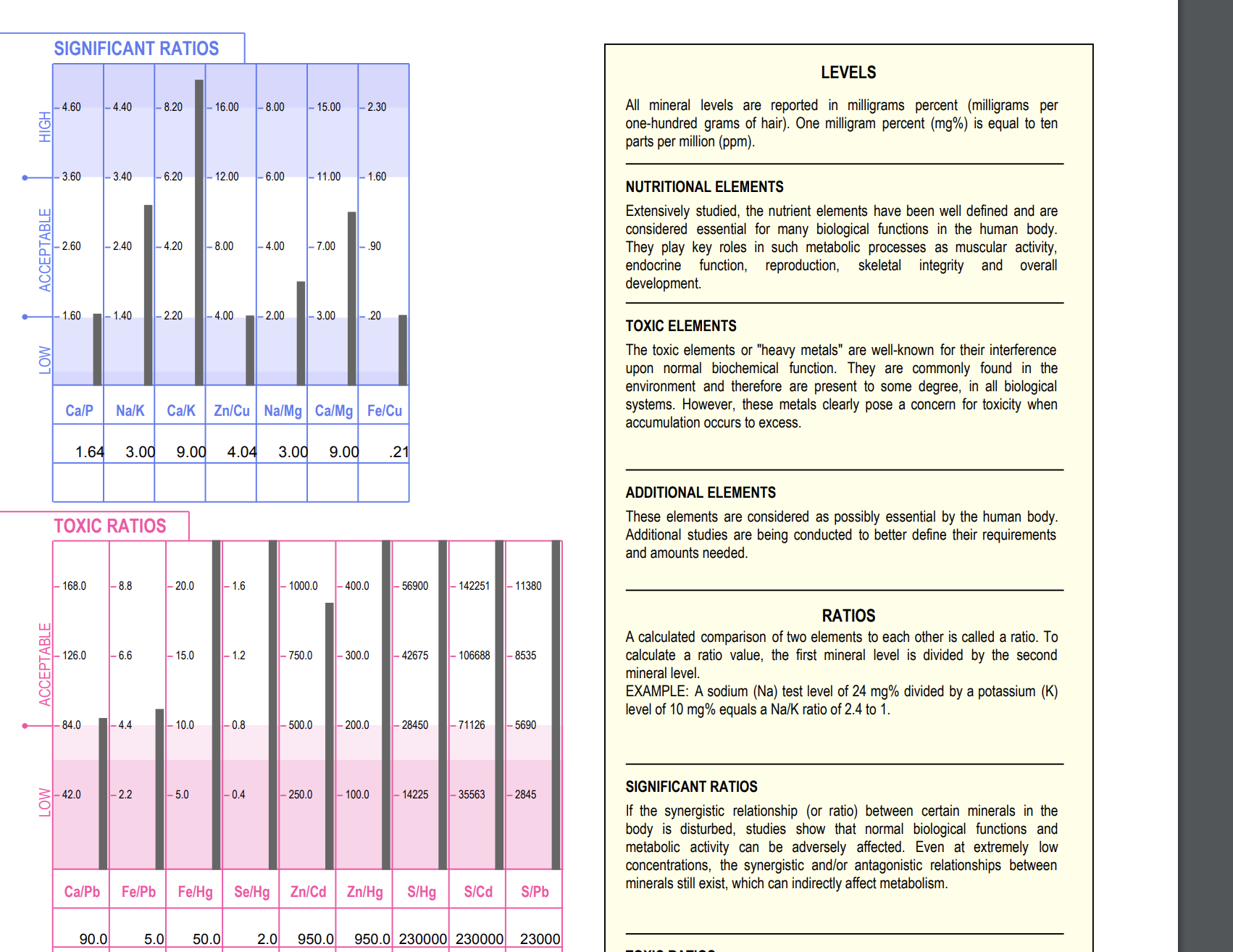
Here's what a real
HTMA report looks like.
No mysterious chart you have to decode alone. You'll get a detailed, personalized breakdown of your patterns — with a recorded video walking through what your specific results mean, and exactly what to do next.

The Package
Everything you get —
delivered on your time.
A complete HTMA assessment from collection to plan, without a single scheduled appointment.
- ✓ At-home hair collection kit mailed to your door — easy collection (about 1 teaspoon of recent growth, cut from underneath layers so it's not visible)
- ✓ A detailed health history + symptoms assessment so your patterns are interpreted in the context of your story — not in isolation
- ✓ Comprehensive written report breaking down your mineral patterns, ratios, metabolic type, and heavy metal trends in plain language
- ✓ Personalized recorded video walkthrough of your results — no live call, ever. Watch on your time, replay, share with your spouse, come back to it later
- ✓ A 3+ month personalized plan — diet, lifestyle, and targeted supplement recommendations matched to your metabolic pattern
- ✓ Option for a custom supplement blend built specifically from your results (great as a personalized prenatal or all-in-one) — available through Vykon if you want it
- ✓ Direct access to your functional practitioner for 48 hours after your recommendations are received — ask follow-up questions through your client message portal, without having to schedule an appointment
- ✓ Up to 25% off Fullscript supplements — ongoing, all orders
No scheduling appointments.
Everything delivered virtually, on your time.
HTMA Test + Practitioner Interpretation
$399
Results in 2–3 weeks after the lab receives your sample
HTMA also works beautifully for kids.
If you're noticing mood swings, focus issues, eczema, sensory sensitivity, or unexplained cavities in your child, HTMA can reveal the foundational patterns underneath — without loading them up with guess-based supplements. The same package and process applies.
If you've been telling yourself "I'll figure this out eventually," every week is another week your body keeps compensating. The sooner you collect, the sooner you have a real plan.
Is this worth it?
Here's why it's actually a deal.
If you've been navigating fatigue, mood, sleep, or hormone issues for any meaningful stretch of time, you've probably already spent $399 — and then some — on things that didn't move the needle.
A round of expensive supplements someone in your DM's recommended.
The functional medicine consult that ended with "let's run a panel" — and then another bill.
The thyroid herbs you tried for three months.
The mineral water, the sea salt protocols, the magnesium glycinate, the trace mineral drops, the adrenal support stack.
Some of those were probably fine. Some may have helped. But without knowing your actual mineral patterns — your ratios, your oxidation type, your stress adaptation — you've been guessing. And guessing gets expensive in a different way: time, energy, and the slow grind of feeling almost-better but never quite right.
This package gives you:
- ✓ The test itself — comprehensive HTMA panel from a clinical lab
- ✓ A detailed personalized report translating your results into language you can actually use (no chart-decoding required)
- ✓ A recorded video walkthrough of your specific patterns — yours to rewatch as you implement
- ✓ A 3+ month plan matched to your metabolic type, not generic recommendations
- ✓ Direct access for follow-up questions — instead of waiting weeks to book another appointment, you get quick written answers
- ✓ Ongoing 25% off Fullscript supplements — yours to keep, often saving $100–200+ over a typical 3-month protocol
You're not paying for a hair test. You're paying to stop guessing.
Why interpretation matters
A chart full of numbers
isn't a plan.
A HTMA report on its own is missing a crucial piece of the puzzle: someone who knows what to do with the data.
Mineral balancing isn't about chasing individual numbers — it's about:
- ✓ Understanding your metabolic type (slow vs. fast oxidation) — different types need distinct support, and getting this wrong is the most common mistake
- ✓ Supporting your ratios in the right order — minerals influence each other, so the sequence of what you support first matters
- ✓ Avoiding the trap of stacking supplements that fight each other — well-intentioned protocols often slow each other down
- ✓ Moving the system gradually — overcorrecting causes its own symptoms, even when the intention is right
I interpret your HTMA in the context of your symptoms, history, diet, stress load, and goals — so you're not left alone with a chart. After hundreds of mineral panels, I've seen what works, what doesn't, and where the patterns lead. That's the part you can't get from an AI summary.
I can't believe it, but I'm sleeping through the night for the first time in decades.
— Mary
Honesty check
Is this right for you?
This is for you if...
- ✓ You've been dealing with fatigue, sleep issues, mood shifts, or hormonal changes that don't show up clearly on bloodwork
- ✓ You want data-driven answers, not another guess-based supplement
- ✓ You'd rather watch a recorded video on your time than sit through a scheduled appointment
- ✓ You're preparing for pregnancy, postpartum, or recovering from a depleting season of life
- ✓ You're willing to make gradual diet, lifestyle, and supplement changes based on your results
- ✓ You're a parent looking to understand what's underneath your child's mood, focus, or skin issues
- ✓ You want a clear plan, not a stack of supplements someone in your DM's said you should try
This is probably not for you if...
- ✕ You're looking for a one-size-fits-all supplement recommendation
- ✕ You want a fast, dramatic protocol — HTMA work is intentionally gradual and gentle
- ✕ You want weekly 1:1 live calls with your practitioner (this is intentionally low-touch)
- ✕ You're not in a position to make any changes right now (HTMA only helps if you're ready to act on what we find)
- ✕ You have significant concerns about removing a small hair sample for testing
About the practitioner

Kelly Shea
FDN-P · Health by the Numbers
I'm a Functional Diagnostic Nutrition Practitioner who works with women navigating exactly what you're navigating right now.
I came to this work the same way most of my clients find me — frustrated and depleted. For years I struggled with hormone imbalances, hair loss, insomnia I couldn't fix, and a level of fatigue that no amount of "rest more" or "manage your stress" could touch. My labs kept coming back "normal." My naturopath told me to cut carbs and move more. My OB told me my hormones looked fine. I was working out more, eating clean, taking the supplements everyone said to take — and feeling worse, not better.
When I finally ran the right functional tests — including HTMA — I started to see the pattern. My minerals were depleted in specific ways my bloodwork couldn't show. My body had been compensating for years, and the slow drain was finally surfacing as symptoms I couldn't ignore. From that data, I built a plan that actually made sense for my body — not a generic protocol, not a one-size-fits-all stack of supplements.
The results weren't immediate or dramatic. They were gradual — energy returning in the afternoons, sleep slowly deepening, mood stabilizing, hair growing back. The pattern shifted because the underlying chemistry shifted. That's how mineral work goes. Slow, steady, real.
That's the work I do now. Over the last several years, I've interpreted hundreds of functional lab panels for women looking for the same kind of clarity. The recorded video format exists because most of my clients don't have time for another scheduled call — they need real answers, delivered in a way that fits their actual life.
In health,
Kelly
Questions
What you might be wondering.
What happens after I order?
How does the at-home hair collection work?
How long until I get my results?
Do I really not have to get on a call?
What if I have more questions after my 48-hour window?
Will this show heavy metal poisoning?
Can I do this while pregnant or breastfeeding?
Is mineral balancing a huge commitment?
Is the supplement blend included?
Is this test HSA eligible?
Important: If you'd like to pay with an HSA card, please check out through my Practice Better client portal here instead of the standard checkout — the standard checkout often won't process HSA cards correctly. A receipt is available upon request either way.
What if my results are mostly normal?
Still have questions?
One last thing
Your body has been compensating
for a long time.
You don't have to keep guessing at what's underneath. After hundreds of mineral panels, here's what I keep seeing: the women who finally test instead of trying one more thing are the ones who stop cycling through protocols that don't work and start feeling like themselves again.
It doesn't happen overnight. But it happens with a plan.
You can order today and have your kit within a few business days.
HTMA Test + Practitioner Interpretation
$399
Everything delivered on your time. No appointment required.
Order My HTMA →In health,
Kelly
You can also complete your purchase directly through the Practice Better portal. The checkout cart below sometimes doesn't load due to internet speed or browser settings. Check out on Practice Better →
bloodwork misses.