MRT Test
MRT Food Sensitivity Testing
Find out which foods are quietly driving your inflammation.
If you feel like you're eating well but still don't feel your best - bloated after meals, foggy in the afternoon, dealing with skin flares or headaches you can't trace - food sensitivities may be part of the picture. The MRT can help you identify foods that are causing internal inflammation, so you stop guessing.
What the test does
A different kind of food sensitivity test.
The Mediator Release Test (MRT), offered through Oxford Biomedical Technologies, is a patented blood test that measures how your white blood cells respond when exposed to 176 different foods and food chemicals.
Rather than measuring antibodies (like IgG panels do), MRT directly quantifies mediator release - the actual inflammatory output of your immune cells. That's a meaningful difference, and it's worth understanding why.
How the test works
White blood cells, mediators, and why this matters.
Every food-induced inflammatory reaction in your body - whether immediate or delayed, whether it triggers digestive symptoms or migraines or skin issues - ultimately comes down to one thing: your white blood cells releasing inflammatory mediators.
These mediators are chemicals like cytokines, prostaglandins, leukotrienes, and histamine. They're what your immune cells (neutrophils, monocytes, eosinophils, and lymphocytes) release when they encounter something they consider a threat. Mediators are the substances that actually cause the symptoms you feel.
Most food sensitivity tests measure antibodies (IgG, IgA), which are only one possible pathway of an immune reaction. Many sensitivity reactions don't involve antibodies at all. MRT skips the antibody question entirely and measures the inflammatory response itself.
Here's how the test runs:
- A blood sample is drawn and sent to Oxford Biomedical Technologies.
- In the lab, your white blood cells are exposed to 176 different foods and food chemicals, one at a time.
- Using patented flow cytometry technology, the lab measures the volume changes in your white blood cells - which indicates mediator release - in response to each substance.
- Each food and chemical is then categorized as non-reactive (green), moderately reactive (yellow), or reactive (red) based on how much your immune cells responded.
The result is a color-coded report showing your most reactive foods, moderately reactive foods, and least reactive (safest) foods - including common triggers like gluten, dairy, eggs, and corn, plus food chemicals like dyes, MSG, aspartame, and salicylates.
About the lab
Why Oxford Biomedical Technologies.
The lab matters as much as the test itself. Oxford Biomedical Technologies developed the MRT and holds the patent on the technology, which means no other lab in the world runs this exact test.
What sets Oxford apart:
- Federally and State of Florida licensed medical reference laboratory
- Patented MRT III technology combining advanced flow cytometry with their proprietary "Ribbon Method" - the only instrument capable of measuring subtle volumetric changes in individual white blood cell populations simultaneously
- Decades of clinical research, including studies on IBS, IBD, migraine, and fibromyalgia
- Used by registered dietitians, functional medicine practitioners, and integrative MDs worldwide
This isn't a direct-to-consumer test you'll find on Amazon. It's a clinical-grade test that requires a practitioner to order, and there's real nuance in how to apply the results - whether that's straightforward elimination of reactive foods, or a more structured approach like the LEAP protocol.
Symptoms that may point to food sensitivities
Reactions you may not realize are food-related.
Food sensitivity reactions are often delayed by hours or even days after eating, which is why elimination diets alone rarely give clear answers. Common symptoms include:
- Digestive discomfort, bloating, or IBS-type symptoms
- Migraines or chronic headaches
- Skin issues like eczema, rashes, or acne
- Fatigue or brain fog
- Joint pain or stiffness
- Mood or focus changes
- Sleep disturbances
Food sensitivities are rarely the only cause of these symptoms, but they often act as an ongoing stressor that makes other health issues harder to resolve.
Why MRT pairs well with GI MAP
Address the foods and the gut together.
Food sensitivities and gut health are tightly linked. A compromised gut barrier ('leaky gut') allows undigested food particles to cross into the bloodstream, where the immune system reacts to them - creating sensitivities. Those sensitivities then fuel more inflammation, which keeps the gut barrier compromised.
It's a self-perpetuating loop. Without addressing the gut, food sensitivities tend to keep developing. Without addressing the reactive foods, the gut never gets the inflammation break it needs to heal.
MRT
Identifies which foods and food chemicals are currently driving inflammation, so we can pull them out short-term and lower the inflammatory load.
GI MAP
Identifies the underlying gut dysfunction - pathogens, dysbiosis, gut immune function, 'leaky gut', inflammation markers - that's contributing to sensitivities in the first place.
Together, they give a much more complete picture and a clearer path forward. Learn more about GI MAP testing here.
MRT and autoimmune conditions
Lowering one of the inputs that fuels autoimmune inflammation.
Food sensitivities are a known driver of intestinal permeability, and intestinal permeability is one of the recognized contributors to the development and flaring of autoimmune disease.
For clients with Hashimoto's, rheumatoid arthritis, psoriasis, lupus, or other autoimmune conditions, identifying and temporarily removing inflammatory food triggers can:
- Lower overall inflammatory burden
- Reduce immune system overactivation
- Support gut barrier repair (which directly impacts autoimmune activity)
- Make it easier to evaluate the impact of other interventions
MRT doesn't diagnose or treat autoimmunity, but it gives a targeted way to reduce one of the inputs that keeps autoimmune inflammation running hot.
What's included
The full package.
MRT 176 (the largest panel)
$695
- MRT 176 test kit shipped to your home (blood draw done at a local lab)
- Full MRT report and interpretation guide from Oxford Biomedical Technologies
- Personalized video walkthrough of your results
- Guidance on integrating results with other testing or symptoms
Why interpretation matters
The goal isn't a permanently restrictive diet.
One of the biggest mistakes with food sensitivity testing is removing too many foods or staying restricted for too long. The goal of MRT is strategic, temporary removal of reactive foods to reduce inflammation and give the body a chance to stabilize - followed by structured reintroduction.
Practitioner interpretation helps:
- Prioritize which foods to remove first
- Prevent overly restrictive eating patterns
- Build a realistic reintroduction plan
- Identify patterns that may point to underlying gut or immune issues
- Integrate results with other testing and symptoms
Without interpretation, many people eliminate unnecessary foods or struggle to put the results to use.
Is MRT right for you?
This may be a good fit if:
- You feel like you're eating well but still don't feel your best
- Your symptoms seem inconsistent or hard to trace to specific foods
- Digestive, skin, or inflammatory symptoms persist despite dietary changes
- You want a structured way to identify food triggers without endless elimination diets
- You have an autoimmune condition and want to reduce dietary inflammatory load
This may not be the right fit if:
- You're looking to confirm a known food allergy (MRT tests sensitivities, not IgE allergies)
- You aren't able to have blood drawn
- Your current diet is already extremely limited
- You aren't willing to temporarily remove reactive foods during the testing phase
- You live in New York State and aren't willing to travel out of state for the blood draw (state regulations require this)
Common questions
FAQ
How is MRT different from an IgG food sensitivity test?
IgG tests measure a single antibody. MRT measures the actual inflammatory response (mediator release) from your white blood cells when exposed to foods and chemicals - regardless of which immune pathway is involved. That makes it a more comprehensive measure of what's actually triggering inflammation in your body.
How is the blood draw handled?
Once you order, the kit ships to your home. You'll bring it to a designated blood draw location local to you (Oxford has a draw locator that I will send you after ordering), and the sample is shipped to Oxford for analysis. Results typically come back quickly - within a few business days.
How long do I need to avoid reactive foods?
This will depend on your overall goals and what else is going on, but I generally start with a timeframe of 3-6 months. The goal is to bring inflammation down enough to allow structured reintroduction - not permanent avoidance. Most foods can come back into the diet over time.
Will MRT diagnose a food allergy?
No. MRT is designed for food sensitivities (delayed inflammatory reactions). True IgE allergies require different testing through an allergist, and if you have a known food allergy you should continue to avoid that food regardless of MRT results.
Should I do MRT or GI MAP first?
If you have to choose one, I'd start with GI MAP. This is because food sensitivities will greatly depend on overall gut health - if your immune function or digestive capacity is lowered, you will react to more foods. As you restore gut health, food-related symptoms often improve. Many clients ultimately benefit from both - and running them together gives the most complete picture so that you are able to temporarily remove inflammatory foods while working on gut repair.
What you'll receive
A look at the sample report.
Below is an example of the MRT report you'll get from Oxford Biomedical Technologies. The actual report does not include the practitioner interpretation and individualized analysis that comes with this package - but this gives you a sense of the broad range of foods tested and how reactivity is displayed.

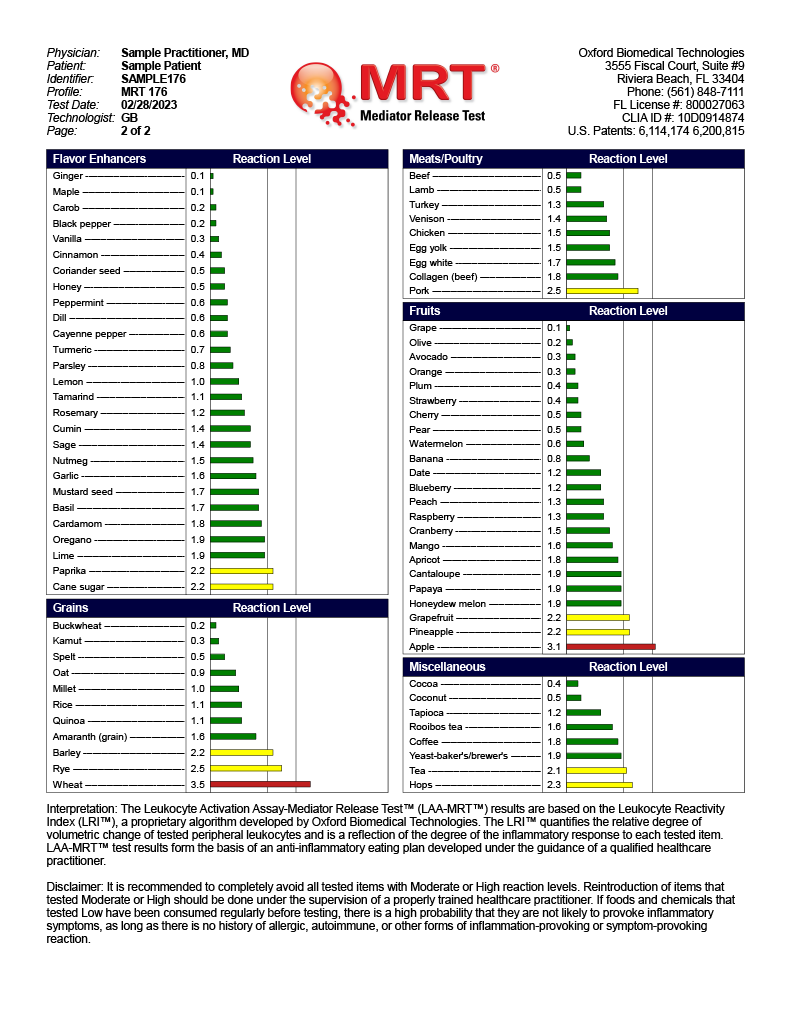
Sample MRT report. Your results will be color-coded by reactivity, with green = least reactive, yellow = moderately reactive, and red = most reactive.
One last thing
You don't have to keep guessing.
If you've been chasing symptoms for a while and food keeps feeling like part of the picture - but you can't pin down which ones - MRT can give you something concrete to work with. Not a permanent list of foods to avoid forever. A starting point.
- Kelly